American Express Membership Rewards is arguably the most flexible rewards currency available to Canadians. Unlike points tied to a single airline or hotel chain, Membership Rewards let you transfer to multiple airline and hotel partners — or use them in other ways if you prefer. This guide is for Canadians who want to understand how MR points actually work, which cards earn them, where they transfer, and how to get real value out of a balance instead of watching it sit idle.
Membership Rewards vs. Membership Rewards Select
This distinction matters more than most people realise, and it's easy to miss because both currencies carry the "Membership Rewards" name on marketing materials.
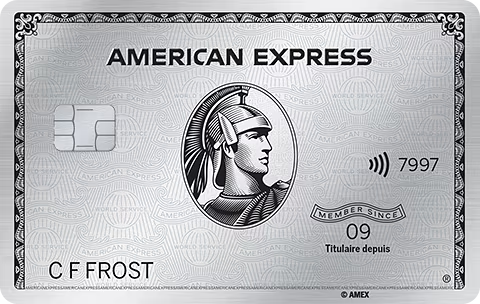
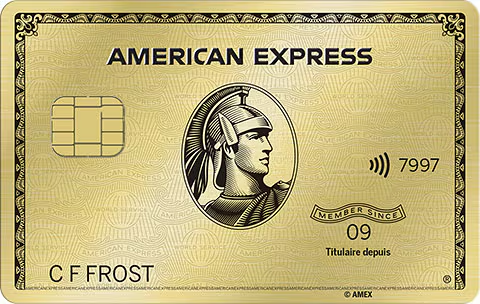
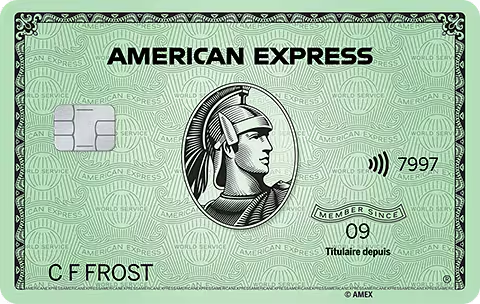
Regular Membership Rewards (MR) are the transferable kind. Cards that earn regular MR give you access to airline and hotel transfer partners, which is where the meaningful travel value comes from. In Canada, the personal cards that earn regular MR are the American Express Cobalt, Gold Rewards Card, Platinum Card, and Green Card. On the business side, the Business Platinum and Business Gold Rewards Card also earn regular MR.
The co-branded Amex Aeroplan cards (Aeroplan, Aeroplan Reserve, Aeroplan Business Reserve) and Amex Marriott Bonvoy cards (Marriott Bonvoy, Marriott Bonvoy Business) are a separate story: they earn their respective loyalty currencies directly — Aeroplan points or Marriott Bonvoy points — rather than MR. That's useful if you already know you want to accumulate Aeroplan or Bonvoy specifically, because you skip the transfer step. It's less flexible than a regular MR card, though, since the points can't be redirected to a different program later.
Membership Rewards Select (MR-Select) is a restricted version of the currency. MR-Select points cannot be transferred to airline or hotel loyalty programs. They can only be applied as statement credits or used through the Amex Travel booking portal. The former American Express Business Edge Card (closed to new applicants in August 2024) earned MR-Select. The other Canadian cards in this category are actually personal, no-fee products — the Choice Card and ChoicePlus Card — rather than the business lineup.
If transferability is your goal — and for most people chasing travel value, it should be — check that you're applying for a card that earns regular MR before you commit. The product pages on amex.ca specify which currency each card earns, though the distinction isn't always prominently displayed. If you're unsure, look for the list of transfer partners in the card's rewards section. If there are no airline partners listed, you're likely looking at MR-Select.
Earning Membership Rewards
The earn landscape for Amex MR in Canada is led by a handful of cards with meaningfully different earn profiles.
The Cobalt Card is the strongest everyday earner in the MR ecosystem. It earns 5x MR points on eligible food and dining purchases — including restaurants, cafés, food delivery apps, and grocery stores — up to $2,500 in combined spending per calendar month. Beyond that cap, food spending drops to 1x. The card also earns 3x on eligible streaming services, 2x on transit, gas, and ride-share, and 1x on everything else. At $15.99 per month ($191.88 per year), it earns its keep quickly for anyone with meaningful food spending. For most Canadians, it's the engine of the MR strategy.
The Gold Rewards Card takes a different approach: 2x points on gas, groceries, drugstores, and travel purchases at eligible standalone merchants. This is a broader multi-category card — note its $250 annual fee is actually a little higher than the Cobalt's $191.88 — and it transfers the same to all MR partners. It suits someone whose spending is distributed across everyday categories rather than concentrated in food and dining.
The Platinum Card earns 2x points on travel purchases and 2x on dining and food delivery, with 1x on everything else. It carries a substantial annual fee, but comes with travel credits, lounge access, and premium insurance that offset the cost for frequent travellers. The Platinum is a travel card first; MR accumulation is secondary to the perks it provides.
The Business Platinum earns 1.25x MR points on all purchases with no category restrictions, which makes it a strong option for business owners who want a flat, predictable earn rate across all business spending, including categories that don't have elevated rates on other cards.
Amex Offers are merchant-specific bonuses that appear in your card account and can add meaningful incremental MR on top of your regular earn rate. These are available across MR-earning cards and are worth checking regularly — a 10x offer at a retailer you already use can significantly accelerate accumulation.
Transfer Partners
This is where regular MR points earn their value. In Canada, American Express has five airline transfer partners and three hotel partners as of July 2026.
| Partner | Transfer Ratio | Best Use |
|---|---|---|
| Aeroplan | 1 MR : 1 Aeroplan | Long-haul Star Alliance premium cabin; best default for Canadians |
| The British Airways Club (Avios) | 1 MR : 1 Avios | Short-haul flights on BA, Iberia, Aer Lingus; intra-Europe routes |
| Air France–KLM Flying Blue | 1 MR : 1 Flying Blue | Europe and Africa routes; monthly Promo Awards for reduced rates |
| Cathay Pacific Asia Miles | 1,000 MR : 750 Asia Miles (1:0.75) | Oneworld carriers connecting through Asia; Cathay premium cabin |
| Delta SkyMiles | 1,000 MR : 750 SkyMiles (1:0.75) | Delta and SkyTeam routes across North America and beyond |
| Marriott Bonvoy | 5 MR : 6 Bonvoy | Hotel redemptions; luxury properties with good points value |
| Hilton Honors | 1 MR : 1 Hilton | Mid-tier hotel stays; typically lower value per point than Bonvoy |
| ALL Accor Live Limitless | 2 MR : 1 ALL Reward point | Accor stays in Europe, Asia and Canada; ALL points offset room rates at a fixed value |
Aeroplan is the default for most Canadians — the 1:1 transfer is clean, and Aeroplan points are worth around 2 cents each on Prince of Travel's current valuation, with well-chosen long-haul premium cabin redemptions landing higher. That's as good as it gets in the Canadian market. If you're accumulating MR primarily to travel internationally, this is where your points should eventually land.
British Airways Avios at 1:1 is a strong option for short-haul redemptions. Avios is distance-based, which means short flights can cost very few Avios — intra-European flights and short North American hops can be excellent value. It's also useful for flights on Iberia and Aer Lingus through the Oneworld alliance.
Flying Blue added a 1:1 transfer ratio from Canadian MR effective January 2026, which improved its attractiveness. Flying Blue's monthly Promo Awards reduce the point cost on select routes by 25–50%, creating windows of very strong value for flexible travellers.
Cathay Pacific Asia Miles transfers at 1,000 MR to 750 Asia Miles — the Canadian ratio is 1:0.75, which is less generous than many of Amex Canada's alliance partners. Asia Miles still has niche value for Oneworld redemptions on Cathay Pacific's own metal through Asia and for connecting Canadians to partners like Japan Airlines and Qantas.
Delta SkyMiles transfers at the same 1,000 MR to 750 SkyMiles Canadian ratio. This is a notable downgrade from the 1:1 that US Amex cardholders receive, so if you're used to hearing US-centric advice about Delta transfers, temper your expectations. Delta can still be useful for transborder routes and SkyTeam connections, but the reduced ratio means you'll want to verify that the specific redemption beats booking through another partner first.
Marriott Bonvoy transfers at 5 MR to 6 Bonvoy — a modest 20% bonus on the standard ratio. This is useful for topping up a Bonvoy balance for an aspirational hotel stay, though Bonvoy redemption values vary widely and it's rarely the most efficient use of MR compared to airline transfers.
Hilton Honors transfers at 1 MR to 1 Hilton Honors point in Canada. The raw ratio is attractive, but Hilton Honors points typically have lower per-point value than Bonvoy, so the math usually favours Bonvoy for hotel redemptions despite the less generous ratio. Use Hilton transfers when you have a specific Hilton stay in mind and need to top up.
ALL Accor Live Limitless became the third hotel partner on July 29, 2026, transferring at 2 MR to 1 ALL Reward point (minimum 1,000 MR, in increments of 100). ALL points redeem against room charges at a fixed value of roughly €2 per 100 points, which makes this a functional — if unspectacular — way to offset stays at Accor brands like Fairmont, Sofitel, and Novotel. As with the other hotel partners, airline transfers will usually beat it on value.
Note that Etihad Guest was removed as an MR transfer partner in Canada on June 20, 2026, and is no longer available.
Redemption Strategies
Transfer to an airline program first. This is, in almost all cases, the highest-value use of MR points. Converting MR to Aeroplan and then booking a business class long-haul flight can yield well above 2 cents per MR point in value. Compare that to the alternatives below, and the gap is stark.
Fixed Points Travel. Amex's own travel booking tool allows you to redeem MR points against flights at a set rate. This can work well for straightforward travel where flexibility isn't a concern and you don't want to navigate award programs, but the per-point value is typically lower than what you'd get from an airline transfer. Think of it as a middle-ground option.
Statement credit — the baseline. Applying MR points as a statement credit against eligible purchases redeems at 1,000 points per $10 — a flat 1.0 cent per point. (The lower 0.7-cent rate applies only to redemptions at Amazon.ca and Pay with Points at PayPal checkout.) This is the floor for a sensible redemption: simple, always available, but well short of what a transfer can return.
The Amex Travel portal. Booking travel with points through the Amex Travel portal generally returns less than 1 cent per point — below even the statement credit. Use it only if your itinerary involves airlines that aren't MR transfer partners and you'd rather spend points than cash, and check the implied per-point value before confirming.
Timing transfer bonuses. American Express runs periodic transfer bonuses — typically 20–30% — to partners like Aeroplan or Marriott Bonvoy. If you're sitting on a large MR balance and have a specific redemption in mind, waiting for a bonus before transferring can add thousands of extra points at no additional cost. These bonuses are unpredictable and not guaranteed, but they appear a few times a year. Track them through Rewards Canada, Prince of Travel, or the Amex Canada promotions page.
Don't redeem for merchandise or gift cards. The value per point on physical goods and gift cards through the Amex catalogue is consistently poor — well below the 1-cent statement-credit baseline. Treat these options as dead ends.
Amex Offers
Amex Offers are merchant-specific promotions that sit in your Amex account and activate when you add them to your card. They come in two forms: bonus MR points on purchases at specific retailers, or statement credit savings.
The bonus MR offers can stack meaningfully with your base earn rate. If your card earns 1x on a particular merchant and an Amex Offer adds 5x, your effective rate becomes 6x for that purchase. Over time, these offers — particularly at retailers you'd shop at anyway — represent a genuine way to accelerate accumulation beyond what your card's base earn rate provides.
In Canada, Amex Offers have become more broadly available across personal and some business MR cards, and it's worth checking your account monthly for new offers. The best ones tend to be targeted and rotate frequently, so there's no guarantee of what you'll see, but for active cardholders they're one of the more consistent sources of incremental MR value.
Common Mistakes
Redeeming for statement credits when airline transfer was an option. This is the most common way to leave MR value on the table. If you can transfer to Aeroplan or Avios and redeem for a flight worth 2 cents or more per point, settling for the statement credit at $0.01 per point roughly halves your return.
Not understanding MR-Select limitations. Getting approved for a card that earns MR-Select and then discovering you can't transfer to Aeroplan is a frustrating experience. Verify which currency a card earns before applying.
Missing transfer bonuses. Transferring MR to Aeroplan the day after a 30% bonus promotion ended is avoidable. Follow Amex Canada promotions through the resources above so you can time larger transfers.
Letting points sit indefinitely. MR points don't expire while your account is open and active, which can create a false sense of security. Programs and transfer partners change — Etihad Guest was dropped in June 2026, for example. Transfer ratios and partner availability are not permanent. If you have a redemption in mind, execute on it rather than waiting for perfect conditions that may not materialise.
Picking the wrong card for your spend profile. A restaurant-heavy spender who gets the Gold Rewards Card over the Cobalt is leaving 3x points per dollar on the table every month. Run the numbers on your actual spending before deciding which MR card to carry as your primary.
FAQs
Do MR points expire? No, as long as your Amex account remains open and in good standing. However, closing your account typically results in forfeiture of your remaining balance. Transfer or redeem your points before closing any card.
Can I transfer MR between my Amex Canada account and an Amex US account? No. Amex Canada and Amex US run separate Membership Rewards programs with separate point balances. Canadian MR transfers to Canadian-eligible partners; you cannot move points across borders.
Can I pool MR with family members? Not in the same way Aeroplan allows Family Sharing. American Express Canada does not offer cross-account point pooling for separate cardholders. However, you can add a family member as an authorized user on your account, and after a 90-day waiting period, you can transfer points to a loyalty program in that authorized user's name.
What's the best Amex Canada card for MR? It depends on your spending. The Cobalt is the right answer for most people who spend heavily on food, dining, and groceries — the 5x rate is hard to beat. The Platinum makes sense for frequent travellers who value lounge access, travel credits, and premium insurance alongside MR accumulation. The Gold Rewards Card suits someone with balanced spending across gas, groceries, and travel who wants a lower annual fee than the Platinum.
Are MR points better than Aeroplan points? It's not quite the right comparison — MR points are a transfer currency that can become Aeroplan points. The advantage of MR over holding Aeroplan directly is flexibility: if a better redemption opportunity opens up through Avios, Flying Blue, or Bonvoy, you can go that route instead. Once you transfer MR to Aeroplan, that flexibility is gone. If you're confident your redemption will be through Aeroplan, holding Aeroplan directly is equivalent. If you want optionality, keep points in MR until you have a clear redemption path.
For a deep dive on how to use Aeroplan points once you've transferred them — including redemption sweet spots, Elite Status mechanics, and the best cards for earning Aeroplan directly — see the Aeroplan guide. To compare all Amex MR cards side by side, use the card comparison tool on the homepage.
Details verified July 2026. Transfer partner ratios and program terms are subject to change. Check americanexpress.com/en-ca for current transfer partner information.
Related Cards

Watch on YouTube
@CreditCardPickerWatch more on our YouTube channel
Credit card tips, comparisons, and strategies