Aeroplan is Canada's largest travel rewards program, and for most Canadians, it's also the most practical way to turn everyday credit card spending into meaningful travel. Whether you fly Air Canada regularly or just want to use points for a business class trip every few years, this guide walks through how the program actually works, which cards make sense for which situations, and how to get the most out of every point you earn.
How Aeroplan Works
Aeroplan is a frequent flyer program that lets you earn and redeem points on Air Canada flights, Star Alliance partner airlines, and a growing list of non-alliance partners. But the part that confuses most new members is how point costs are set — because there's no single price list: Air Canada's own flights are priced dynamically, while most partner airlines still follow a fixed chart.
Since the program relaunched in November 2020, flight rewards have been priced by distance and region rather than by destination. Instead of saying "Canada to Europe costs X points," Aeroplan's Flight Reward Chart prices an award by the actual distance flown on your itinerary and the regions you fly between. It divides the world into four regions — North America (including Mexico, Central America, and the Caribbean), Atlantic (Europe, Africa, the Middle East, India, and Central Asia), Pacific (East and Southeast Asia, Australia, New Zealand, and the rest of Oceania), and South America — and then sets distance bands for each pair of regions. When an itinerary includes a partner-operated flight, that's the total distance flown, so a connection or detour can push a trip into a higher band than the nonstop route would. Itineraries entirely on Air Canada are priced on the direct distance between origin and destination.
The practical upshot: point costs vary route by route, and on some airlines they vary with demand as well. Flights operated by Air Canada are priced dynamically, and since March 2025 so are United, Emirates, Flydubai, Etihad, Calm Air, Canadian North, and PAL Airlines; Bearskin Airlines joined that group when it returned as a partner in October 2025. On these airlines the chart lists only a starting price (plus a median on routes to or from North America), and the actual cost fluctuates like a cash fare. Every other partner — most of Star Alliance, plus non-alliance partners — uses the fixed chart: one set price per distance band and cabin. Always check the current cost on aircanada.com/aeroplan before planning around a specific point target.
Earning Aeroplan Points
There are three meaningful ways to build your Aeroplan balance: flying, credit cards, and transferring in from American Express Membership Rewards.
Flying Air Canada and Star Alliance partners. When you fly on an Air Canada or Star Alliance-operated flight, the points you earn depend on your fare class and whether you have Elite Status. Starting in 2026, Air Canada moved to a revenue-based earning model: members earn at least 1 Aeroplan point per CAD $1 spent on base fare and carrier surcharges. Elite members earn significantly more — between 2x and 6x depending on their status tier. Points earned through partner airlines vary and are governed by each airline's own earn chart.
Co-branded credit cards. This is where most Canadians accumulate the bulk of their points. Here are the main cards and their audited earn rates:
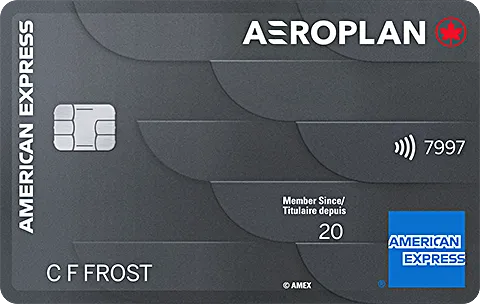
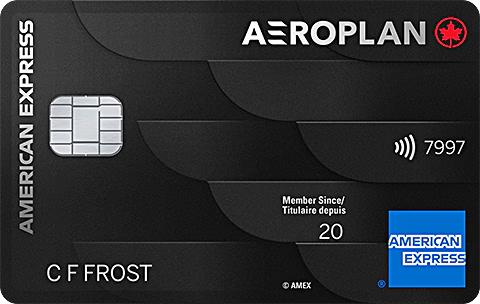
- American Express Aeroplan Reserve: 3x on Air Canada purchases, 2x on dining and food delivery, 1.25x on everything else. $599 annual fee.
- American Express Aeroplan Business Reserve: 3x on Air Canada, 2x on hotels and car rentals, 1.25x on everything else including dining. $599 annual fee.
- American Express Aeroplan: 2x on Air Canada, 1.5x on dining and food delivery, 1x on everything else. $120 annual fee.
- CIBC Aeroplan Visa Infinite Privilege: 2x on Air Canada, 1.5x on groceries, gas, dining, travel, and EV charging, 1.25x on everything else. Unlimited Maple Leaf Lounge access. $599 annual fee.
- CIBC Aeroplan Visa Infinite: 1.5x on groceries, gas, EV charging, and Air Canada purchases; 1x on everything else. Free first checked bag on Air Canada. $139 annual fee.
- CIBC Aeroplan Visa Card: 1 point per $1 on groceries, gas, and Air Canada; 1 point per $1.50 on everything else. No annual fee.
- TD Aeroplan Visa Infinite Privilege: 2x on Air Canada, 1.5x on gas, groceries, dining, travel, transit, and EV charging (subject to a $100,000 combined annual cap), 1.25x on everything else. Unlimited Maple Leaf Lounge and Café access in North America. $599 annual fee.
- TD Aeroplan Visa Infinite: 1.5x on groceries, gas, and Air Canada (subject to an $80,000 combined annual cap); 1x on everything else. Free first checked bag on Air Canada. $139 annual fee.
- TD Aeroplan Visa Platinum: 1 point per $1 on groceries, gas, and Air Canada; 1 point per $1.50 on everything else. No stated minimum income requirement. $89 annual fee.
Transferring from Amex Membership Rewards. Most personal Amex cards that earn regular Membership Rewards points — including the Cobalt, Gold Rewards, and Platinum — transfer to Aeroplan at a 1:1 ratio. This is a powerful earn path, particularly via the Cobalt Card's 5x on food and dining. More on this in the next section.
Shopping and dining partners. The Aeroplan eStore and dining partners let you earn incremental points on everyday purchases. These are worth using but rarely move the needle on their own — treat them as a supplement to credit card spend, not a strategy.
Best Canadian Credit Cards for Aeroplan
Premium tier
If you fly Air Canada frequently and want lounge access, the premium cards are worth their steep fees. The American Express Aeroplan Reserve is the only personal Amex card that earns Aeroplan directly at a premium rate — 3x on Air Canada, 2x on dining — and it includes Maple Leaf Lounge access. (Business owners get the same 3x on Air Canada from the Aeroplan Business Reserve.) The CIBC Aeroplan Visa Infinite Privilege also unlocks unlimited Maple Leaf Lounge access and earns 1.5x across groceries, gas, dining, travel, and EV charging, which is a broader earning footprint. The TD Aeroplan Visa Infinite Privilege matches on lounge access and extends its 1.5x tier to include transit, though the $100,000 combined annual cap on accelerated categories is something frequent heavy spenders will eventually hit.
All three carry a $599 annual fee. The right choice depends on your bank relationship and whether you prefer Amex, Visa for CIBC, or Visa for TD — the lounge access and earn rates are broadly comparable at the top tier.
Mid-tier
The Amex Aeroplan ($120) and TD Aeroplan Visa Infinite ($139) anchor the mid-tier and earn 1.5x in their best categories. The Amex earns 1.5x on dining specifically; the TD earns 1.5x on groceries, gas, and Air Canada. Neither is transformative, but they're solid for someone who wants a dedicated Aeroplan card without the premium fee.
Entry and no-fee
The CIBC Aeroplan Visa Card is the only no-fee Aeroplan card among the major issuers. The TD Aeroplan Visa Platinum is close at $89 with no income requirement — useful if you don't qualify for Infinite products. Both earn at the base rate of 1 point per $1 on core categories, which is unexciting but at least gets you accumulating.
The Cobalt angle
The American Express Cobalt earns 5x Amex Membership Rewards points on food, dining, groceries, and food delivery (up to $2,500 per month), which you can then transfer 1:1 to Aeroplan. At 5 Aeroplan points per dollar on food spending, the Cobalt often outpaces even the premium co-branded cards for people whose lives run through restaurants and grocery stores. If Aeroplan is the destination but you want the best earn rate on everyday spending, the Cobalt is worth considering alongside a co-branded card.
Redeeming Aeroplan Points for Best Value
The gap between "okay" and "excellent" Aeroplan redemptions is wide. Here's where the value is and where it is not.
Short-haul domestic economy. Flights under 500 miles within North America start at 6,000 points in economy. That's the fixed price on partner airlines and the starting price on Air Canada, whose dynamic prices often run higher. These are fine for using up small balances but not where you maximise value per point.
Long-haul premium cabin — the sweet spot. The highest value from Aeroplan points consistently comes from booking business or first class on long international routes. Under the chart effective June 1, 2026, business class from Canada to Europe on fixed-price partners such as Lufthansa, SWISS, or TAP Air Portugal is 60,000, 75,000, or 90,000 points one-way, depending on distance — and the band that matters most to Canadian readers is the first one: Montreal to most of Western Europe, and Toronto to London, Paris, Amsterdam, or Frankfurt, falls under 4,000 miles and prices at 60,000 points. Toronto to Zurich or Munich is just over 4,000 miles, so it tips into the 75,000 band. Canada to East and Southeast Asia in business class on carriers like ANA or EVA Air follows the same logic: 55,000 points under 5,000 miles (Vancouver to Tokyo, for example), 85,000 up to 7,500 miles, 102,500 up to 11,000 miles, and 115,000 beyond that. (India is in the Atlantic region, so it prices on the Europe table.) The June 2026 revision raised those two middle bands from 75,000 and 87,500, so longer trips such as Toronto to Southeast Asia cost noticeably more than they used to. On routes that would otherwise cost several thousand dollars CAD in cash, these redemptions commonly return 2 cents or more per point — well above the roughly 1–1.5 cents of a typical economy or cash-equivalent redemption.
Non-alliance partners. Emirates, Etihad, and Cathay Pacific are all bookable through Aeroplan. Note that Emirates and Etihad moved to dynamic pricing in March 2025, so award costs on those carriers now fluctuate. When availability opens at reasonable point costs, business class on these carriers can represent outstanding value.
Stopovers. Aeroplan allows you to add a stopover — a layover of more than 24 hours — to a one-way international itinerary for 5,000 extra points per passenger. This means you can effectively visit two destinations on a single award. The stopover must be outside Canada, the United States, and China. On a round-trip, you get two stopovers (one per direction) for 5,000 points each.
Taxes and fees. One of Aeroplan's signature strengths: it does not pass on carrier-imposed fuel surcharges for any airline, its own or partners — a genuine advantage over programs like British Airways' that do. What you will pay is a $39 CAD partner booking fee per ticket on itineraries that include a non-Air-Canada-operated flight, plus government taxes and airport fees, which on business class can still add up to a few hundred dollars CAD depending on the route. Factor this in when comparing redemption options.
What to avoid. Redeeming Aeroplan points through the Aeroplan Travel portal for hotels, cruises, or vacation packages typically yields around 1 cent per point or less. Merchandise and gift cards are even worse. Reserve your points for flight redemptions where the per-point value meaningfully exceeds what cashback or cheaper alternatives could provide.
Aeroplan Elite Status
Aeroplan Elite Status runs from 25K at the entry level up through 35K, 50K, 75K, and Super Elite at the top. For most of Aeroplan's history, status was earned through Status Qualifying Miles (SQM) or Segments (SQS) plus a spending threshold in Status Qualifying Dollars (SQD). In 2026, Air Canada consolidated all of these into a single unified metric: Status Qualifying Credits (SQC).
The SQC thresholds for 2026 are:
- 25K: 25,000 SQC
- 35K: 35,000 SQC
- 50K: 50,000 SQC
- 75K: 75,000 SQC
- Super Elite: 125,000 SQC
SQC are earned primarily through Air Canada flight purchases, based on the fare paid and fare type. You can also earn up to 25,000 SQC per year through eligible Aeroplan credit card spending, and the rate differs sharply by card tier: premium cards (Amex Aeroplan Reserve, CIBC and TD Aeroplan Visa Infinite Privilege) earn 1,000 SQC per $5,000 spent, while core cards (Amex Aeroplan, CIBC and TD Aeroplan Visa Infinite) earn 1,000 SQC per $20,000 spent — a fourfold difference that makes the premium cards the only realistic spend-based path for status-chasers. Separately, Aeroplan partners carry their own 25,000 SQC annual cap at 1 SQC per 5 base points — independent of the credit card cap, so the two stack. Since August 2026 that partner bucket includes mortgage payments through Chexy; see our Chexy mortgage and Aeroplan guide for how to combine both buckets. There's also a no-flying alternative: Everyday Status Qualification grants 25K status for earning 100,000 Aeroplan points in a calendar year through any combination of card spend and partners.
Benefits scale with status. At 25K, members receive priority check-in, priority boarding, and eUpgrade credits earned through the Milestone Benefits system as you accumulate SQC. Higher tiers (35K, 50K, 75K, Super Elite) unlock additional eUpgrade credits, Maple Leaf Lounge access (limited at lower tiers and unlimited at higher ones), guest passes, dedicated phone lines, and Star Alliance Gold standing at 50K and above. Super Elite members receive the most comprehensive package, including the strongest upgrade priority on Air Canada flights and access to Air Canada Signature Suites where available.
Common Mistakes
Redeeming for hotels and merchandise through the Aeroplan portal. Hotel redemptions and gift cards through Aeroplan's own travel portal typically yield around 1 cent per point or less. Your points are worth significantly more on flights. Avoid this path unless you have no other use for a small balance.
Burning points on short cash-equivalent flights. If a flight costs $150 CAD and requires 20,000 points, you're getting 0.75 cents per point — worse than just paying cash and saving the points for a premium cabin redemption.
Ignoring taxes and fees. Government taxes, airport charges, and the $39 partner booking fee vary by route. Always check the all-in cost — points plus fees — before booking. The fees on a business class award can sometimes change the value calculus significantly.
Missing transfer bonuses. American Express periodically runs 20–30% transfer bonuses from Membership Rewards to Aeroplan. If you're sitting on a large Amex MR balance and planning a transfer anyway, waiting for a bonus can net you 20,000+ extra Aeroplan points at no cost.
Forgetting the 5,000-point stopover. Adding a stopover to an international one-way award for 5,000 points per person is one of the most underused features of the program. If you're booking a trip to Europe and have any flexibility, consider routing through a city you want to visit.
FAQs
Do Aeroplan points expire? The standard policy is 18 months: if there is no earning or redemption activity on your account within 18 months, your points expire. Activity from a Family Sharing pool member counts for all members in the pool. Air Canada has said points won't expire through November 29, 2026, with the standard policy resuming effective November 30, 2026 — but note the big exemptions: primary cardholders of Aeroplan co-branded credit cards, Aeroplan Elite Status members, and members under 18 are exempt from expiry entirely. For anyone holding one of the cards in this guide, expiry is effectively a non-issue while the card stays open.
Can I share Aeroplan points with family? Yes. Aeroplan's Family Sharing feature lets up to eight household members pool their points into a shared balance. Members keep their individual accounts and earn separately, but points flow into the shared pool for redemption. Members of the same pool benefit from preferred pricing if any primary cardholder is in the pool.
Are Aeroplan points better than cashback? For premium cabin flight redemptions, yes — often by a significant margin. For merchandise, hotel bookings through the Aeroplan portal, or gift cards, cashback will almost always serve you better. The value of Aeroplan points is what you make of it.
What happened to Air Canada Altitude? Altitude was the old name for Air Canada's frequent flyer status program. It merged into Aeroplan in 2020. What was previously called Altitude status is now called Aeroplan Elite Status, and the benefits and tier structure have been consolidated under the Aeroplan brand.
What's the best card to start earning Aeroplan? If you want no annual fee, the CIBC Aeroplan Visa Card is your entry point. If you can manage an $89 annual fee and don't meet Infinite income requirements, the TD Aeroplan Visa Platinum is worth considering for its accessible qualification criteria. If you want the best earn rate on food spending and don't mind an indirect path, the American Express Cobalt earns 5x MR points on food and dining that transfer 1:1 to Aeroplan — making it one of the strongest Aeroplan accumulation tools available.
If you hold or are considering an American Express card, the companion guide on Amex Membership Rewards explains how MR points work, which cards earn transferable points versus MR-Select, and how to time your transfers to Aeroplan. For a full side-by-side comparison of all Aeroplan credit cards, see the card comparison tool on the homepage.
Details verified July 2026. Award-chart figures re-checked October 2026 against Aeroplan's Flight Reward Chart (prices effective June 1, 2026). Aeroplan program mechanics, earn rates, and Elite Status qualification are subject to change. Check aircanada.com/aeroplan for current information.
Related Cards


Watch on YouTube
@CreditCardPickerWatch more on our YouTube channel
Credit card tips, comparisons, and strategies